

Introduction
Much of the enterprise discussion around AI still revolves around tools. Which model is better. Which copilot is cheaper. Which platform has the stronger integration catalogue. Those are valid questions, but they rarely determine whether an organisation truly gains an advantage.
The winners of the next few years will not simply be companies that use AI. They will be AI hybrid companies: organisations that deliberately redesign which work is done by people, which by machines, and where human judgement, accountability, and control remain essential.
This is not science fiction. It is an operating-model question.
What does “AI hybrid company” mean?
An AI hybrid company is not defined by having ChatGPT licences and a few automated workflows. It becomes hybrid when human-AI collaboration appears in the basic units of how the company works.
That becomes visible on three levels:
-
At the task level
Parts of a process are redistributed. Research, first drafts, data reconciliation, summarisation, and quality checks are no longer done the same way. -
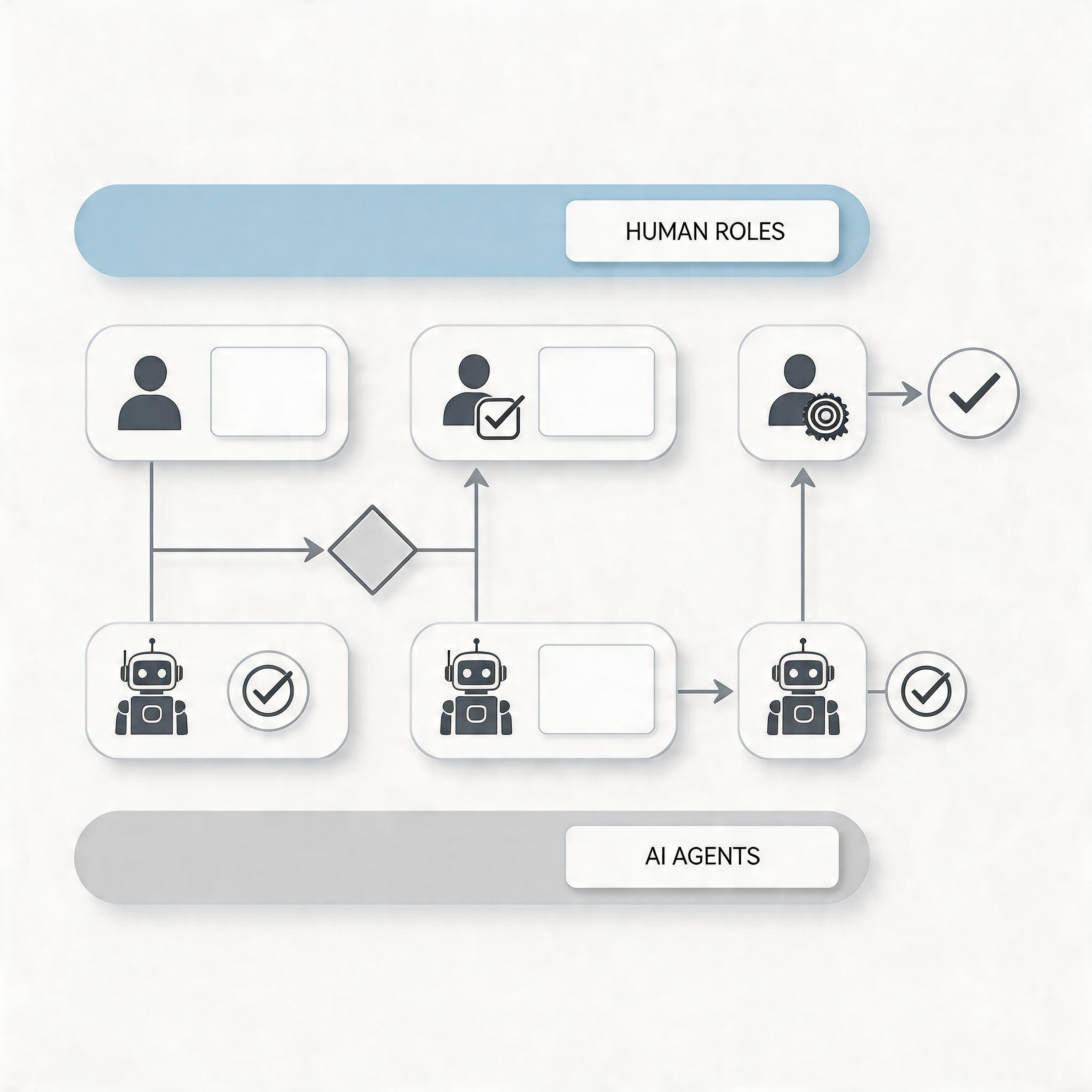
At the role level
New tools are not the only change. New accountability patterns appear too. Who prompts. Who validates. Who carries business responsibility for an AI-supported decision. -
At the organisational level
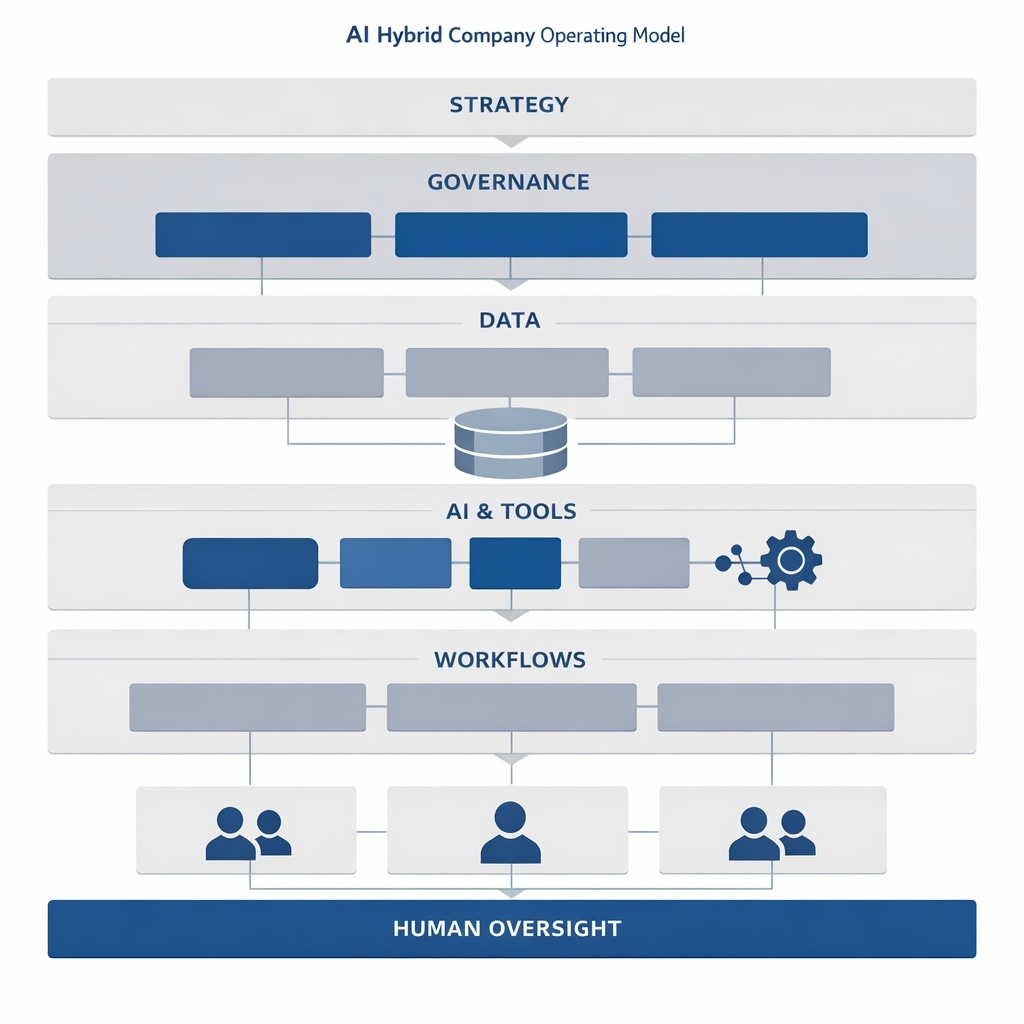
Processes, control points, performance measurement, and competency models all adapt to the fact that some work is now produced with machine support.
That leads to an important conclusion: AI adoption is not an IT project. It is enterprise operating-model redesign.
Why will this become the company of the future?
Because in most industries the main question will no longer be whether a company uses AI, but how deeply it has embedded AI into the way it operates.
In the first wave everyone experiments with tools. In the second wave some companies automate parts of processes. In the third wave the winners are those that reorganise the work itself.
This resembles earlier digitisation cycles, just at a faster speed. Those who only digitised paper gained limited advantage. Those who redesigned the whole process became sustainably faster and cheaper. AI brings the same pattern back, but now at the level of knowledge work.
The four pillars of AI hybrid operations
1. Work allocation between people and machines
The useful question is not “what is AI good for?” but rather:
- which step it accelerates,
- which step it prepares,
- which step it supports,
- and which step still requires a human decision.
A well-run company does not prescribe generic AI usage. It designs task-level work allocation.
2. Decision rights and accountability
This is where many pilots fail. The AI can make a recommendation, but it is unclear who approves it, who checks it, and who owns the consequence of an error.
In a hybrid model it must always be clear which outputs are:
- prepared by AI,
- validated by a human,
- or eligible for automatic execution.
Where that distinction is missing, trust eventually erodes.
3. Platform and data access
It is possible to operate poorly without AI. With bad data, AI just lets a company operate poorly faster.
That is why one of the keys to a hybrid company is not the model choice itself, but how context is supplied:
- which documents the model can see,
- which business data it can reach,
- under which access boundaries,
- and how auditable the usage is.
4. Measurement and learning
Most organisations measure output, but in AI environments it is worth separately tracking:
- time saved,
- error rate,
- human rework,
- adoption rate,
- and changes in decision quality.
Not every acceleration creates value. If review time goes up, the benefit can disappear quickly.
Which business areas move fastest?
In practice, four areas tend to show visible results the fastest:
Knowledge work and document-heavy functions
Legal preparation, business analysis, project documentation, architecture artefacts, and support knowledge bases.
Internal operations and reporting
AI is useful for summaries, condensation, status-report drafting, and variance detection.
Sales and customer service
Proposal drafting, meeting summaries, next-best-action suggestions, and customer-need structuring.
IT delivery and engineering
Code generation, test drafting, documentation, impact analysis, and incident summaries.
Not because AI is “smarter” there, but because the proportion of repetitive knowledge work is high.
What do companies get wrong early on?
1. Buying tools without an operating model
They purchase the platform before defining the use case, the decision pattern, and the controls.
2. Running pilots without a business owner
The AI project stays inside IT, even though the real value would be created on the business side.
3. Choosing use cases that are too broad
Goals like “let’s use AI across all of HR” rarely work. Specific and bounded sub-processes do.
4. Underestimating the competency question
It is not enough to teach the tools. New work patterns have to be taught as well.
A simple architecture for getting started

If a company wants to start today, it should not begin by building a full enterprise AI programme. A four-step pattern works much better.
1. Choose a major pain point
Pick a place with a lot of manual, repetitive knowledge work.
2. Break it into micro-steps
Do not automate the whole process. Target sub-tasks.
3. Map the human-AI handoff points
Where does AI prepare. Where does a person approve. Where does control step in.
4. Measure from day one
Time, quality, rework, and adoption.
That is already enough for a meaningful pilot.
What changes at leadership level?
An AI hybrid company does not only rewrite execution. It also rewrites leadership.
Leaders will be less responsible for checking every output directly, and more responsible for:
- setting sound operating boundaries,
- defining clear accountability lines,
- ensuring the right data and access environment,
- and measuring where AI support works well as part of a learning organisation.
The future leader becomes less “the centre of every decision” and more of a system designer.
Closing
AI hybrid companies will not remain futuristic exceptions. Step by step they will become the new norm. Not because people disappear, but because strong companies learn how to redistribute work between people and machines.
So the decisive question is not whether AI belongs in the company.
It is this: what kind of company do we want to be when AI is no longer a separate tool, but part of the operating model itself?