


Introduction
Many AI roadmaps are actually tool lists. Models, copilots, vector databases, prompt libraries, agent frameworks. That may be technologically interesting, but from an organisational perspective it is often still half-formed thinking.
A company does not operate as a toolbox. A company operates through an operating model.
What is the difference between a toolbox and an operating model?
A toolbox tells you which tools you have. An operating model tells you:
- who may use them,
- in which process,
- from which data,
- under which controls,
- and with responsibility for which outcome.
You cannot solve problems without tools. But with tools alone you still do not have an operating system for the company.
The five questions of an AI operating model
1. Where is the business value?
In which processes does AI create meaningful acceleration or quality improvement?
2. Who owns it?
Which business area owns the use case?
3. What is approved behaviour?
Which data can be used, in which environment, and which outputs may move forward?
4. Who checks quality?
Where do review, audit, and monitoring happen?
5. How does the organisation learn?
Which measurements change the rules or the scaling decision?
Those five questions create more value than buying ten additional tools.
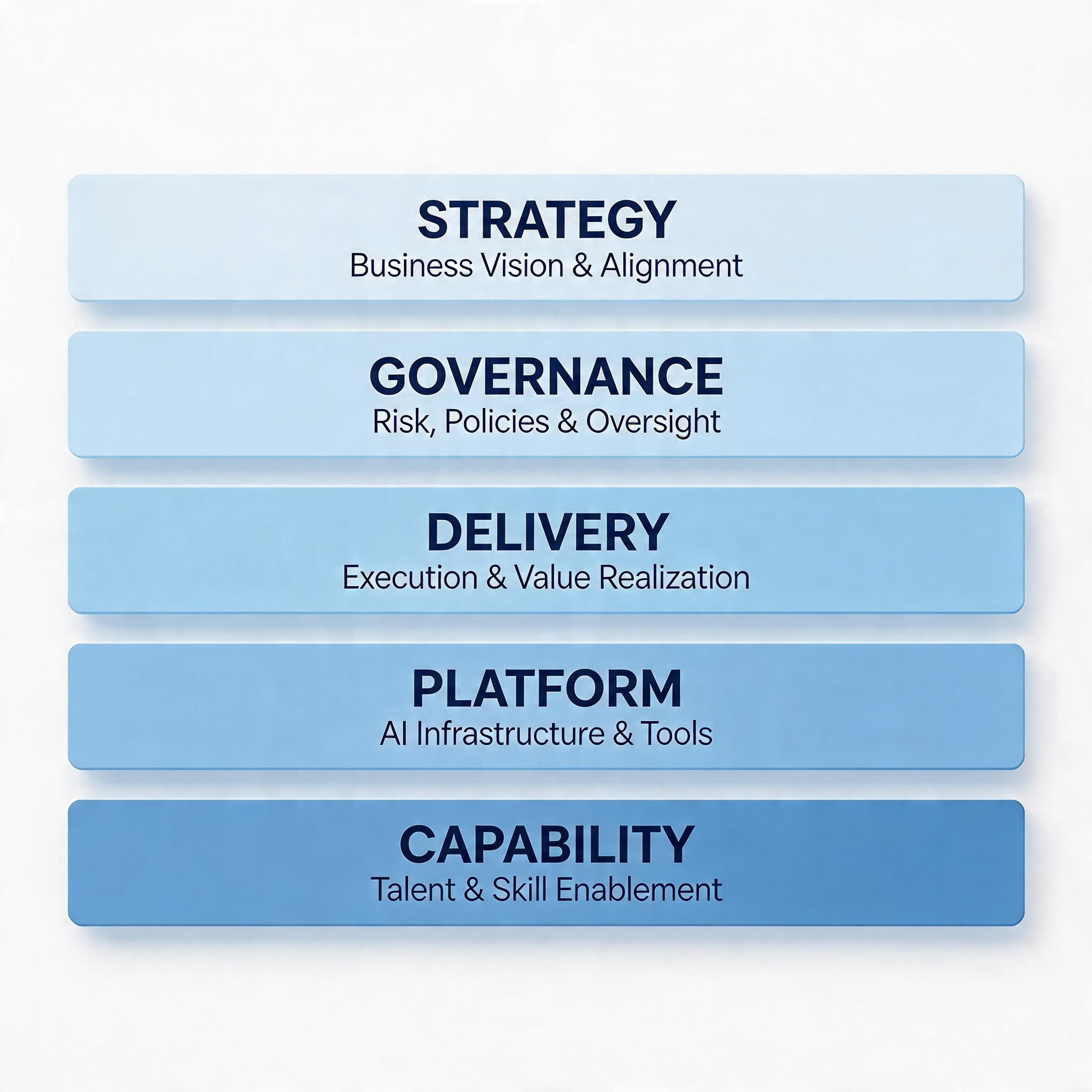
Which layers should the operating model contain?
Strategic layer
Why is the company using AI? Cost reduction, acceleration, better decisions, new services?
Governance layer
Who approves use cases? Who owns compliance and security responsibility?
Delivery layer
How does a use case move from idea through pilot into live operation?
Platform layer
Which models, integrations, permissions, and logging mechanisms exist?
Capability layer
Who can design use cases, prompt effectively, validate, and measure?
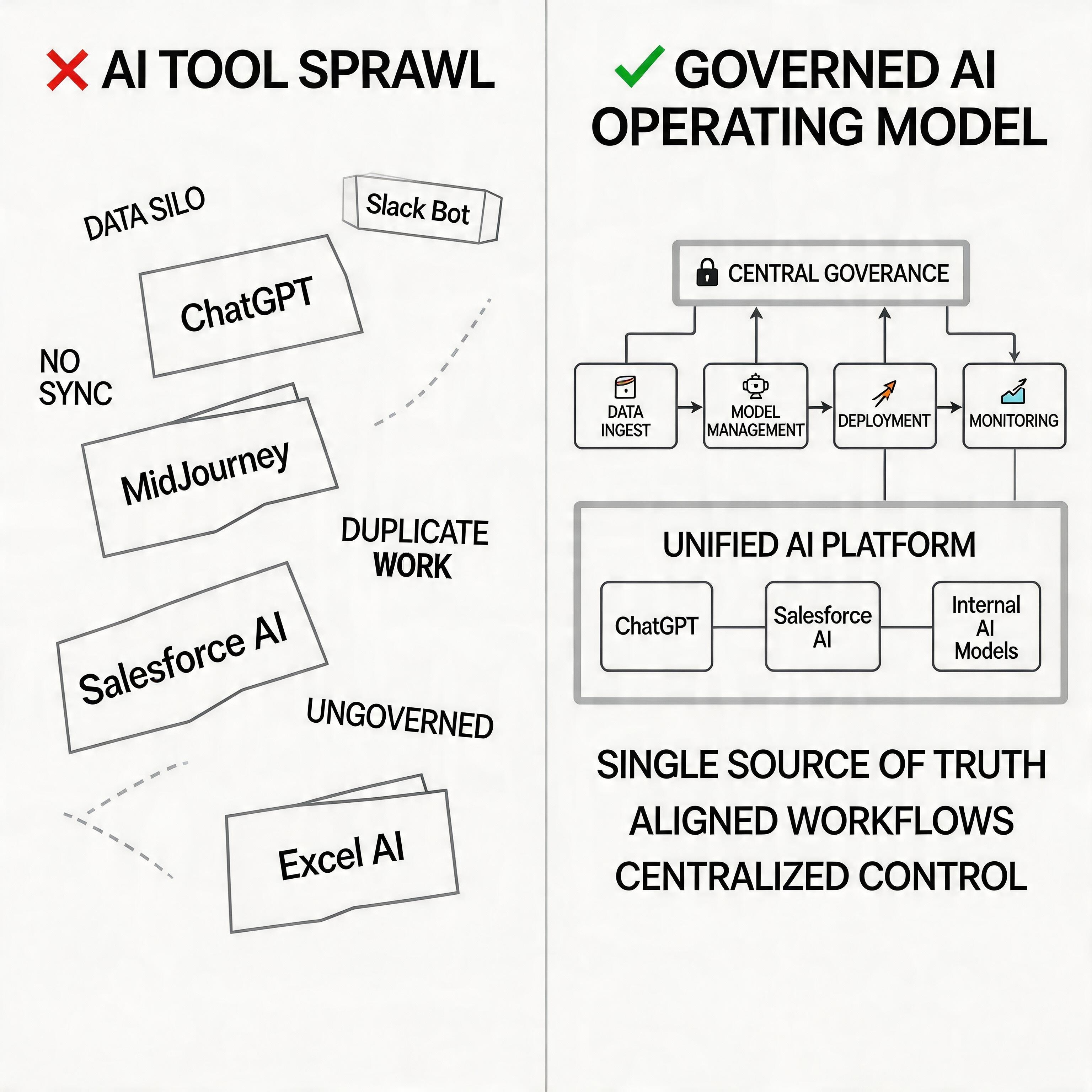
Why is tool sprawl dangerous?
Because each tool often looks useful in isolation. But globally:
- cost goes up,
- risk goes up,
- data handling fragments,
- the user experience becomes inconsistent,
- and comparable measurement disappears.
The result is a state where “AI exists everywhere, but maturity exists nowhere”.
What should an architect do?
Here the architect is not just a platform specialist. The role is closer to an organiser of coherence.
That can include:
- designing a reference use-case structure,
- defining standard control points,
- creating platform and data-access patterns,
- and ensuring comparability across pilots.
A strong architect does not prove value by introducing another tool. They prove value by helping the company create more impact with less chaos.
Closing
In AI, the first maturity leap is rarely technological. It is operational.
Companies do not primarily need more boxes. They need a clearer operating model. In the end what matters is not how many tools they used, but whether those tools became a consistent company capability.